Osteopathic & Visceral Manual Therapy Training: When More Techniques Are No Longer Enough
Most manual therapists reach a point in their career when another technique is no longer the answer.
You may already have a substantial toolbox.
You know how to work with muscles, fascia, joints, the cranium, the viscera, or the nervous system. You have taken courses, studied anatomy, and probably developed techniques that work very well for many of your clients.
And yet there are still those clients.
The ones whose symptoms keep returning.
The person whose shoulder continues to tighten no matter how effectively you treat the shoulder.
The chronic low back pain that improves for several days and then returns.
The client whose body seems to be compensating in several different places at once.
At some point, a different question begins to emerge:
Instead of asking, “What technique should I use?” perhaps the more important question is, “Where does this person’s body actually need me to work?”
That distinction can completely change a treatment.
The Body Does Not Organize Itself by Technique
The body does not know whether we are performing craniosacral work, visceral work, structural work, myofascial work, or something else.
It functions as one interconnected living system.
A restriction around an organ may influence the spine.
A spinal restriction may influence the dural system.
Tension within membranes may alter how force moves through the body.
A restriction in one area can create compensations somewhere that appears completely unrelated.
This is one reason treating the location of symptoms does not always create lasting change.
The painful area may be important, but it may also be adapting to something happening somewhere else.
The challenge for the practitioner is learning how to tell the difference.
Assessment Changes Everything
Over many years of clinical practice, I have become increasingly interested in what happens before we begin treating.
Can we listen to the body well enough to determine where it is organizing around restriction?
Can we distinguish a more primary problem from a compensation?
Can our hands tell us when we are working in a meaningful area — and when we are simply working somewhere that happens to be tight?
When assessment becomes more precise, treatment often becomes simpler.
Instead of doing more, we can become more specific.
Rather than moving systematically through a collection of techniques, the treatment can unfold according to what we find.
That requires a different kind of skill.
It requires anatomy, certainly.
But it also requires perception.
Developing Hands That Can Think
One of the deepest skills in manual therapy is not simply learning what to do with your hands.
It is learning how to receive information through them.
What tissue am I actually contacting?
Where is movement restricted?
What happens elsewhere in the body when I engage this structure?
Is this restriction important to the whole system, or is it compensatory?
What changes after treatment?
These are skills that develop through repetition, feedback, anatomy, clinical reasoning, and time.
And they are difficult to learn in a weekend.
That is one of the reasons I teach this work over the course of an entire year.
Why a Year-Long Training?
My upcoming 12-Month Training in Bend, Oregon begins in April 2027 and consists of ten two-day weekends spread across the year.
The time between classes is intentional.
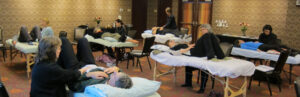
Students learn an assessment or treatment principle, take it back into their practices, work with it repeatedly, discover where they have questions, and then return for the next layer.
As the year progresses, we explore relationships involving the spine, ribs, dural system, organs, membranes, thorax, pelvis, nervous system, and other structures.
But the objective is not simply to accumulate more techniques.
The deeper goal is to develop a way of seeing, feeling, and thinking that can guide your hands throughout an entire treatment — and throughout your career.
Each weekend builds upon what came before.
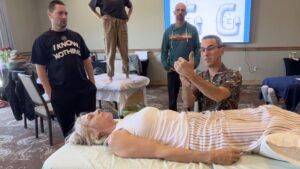
I also offer a demonstration treatment each weekend, giving students an opportunity to watch how I assess, make clinical decisions, follow what the body is presenting, and allow a complete treatment to unfold in real time.
Seeing the entire process can be very different from learning individual techniques in isolation.
It gives students a chance to observe how assessment and treatment continually inform one another throughout a session.
From Following Protocols to Following the Person
Protocols are useful when we are learning.
But ultimately, no two bodies organize themselves exactly the same way.
Two people may arrive with nearly identical symptoms and require completely different treatments.
One of the central abilities I want students to develop is the capacity to walk into a treatment without already deciding what they are going to do.
Instead:
- Assess.
- Listen.
- Treat what appears meaningful.
- Reassess.
Then allow the information from the body to determine what happens next.
That is a very different way of practicing.
And once it begins to become reliable, treatment can become both more precise and surprisingly simple.
For the Practitioner Who Knows There Is More
This training is intended for practitioners who already sense that another collection of techniques is not necessarily what they need.
You may be looking for a way to bring the skills you already have together.
You may want more confidence determining where to begin a treatment.
You may want to understand why some chronic patterns repeatedly return.
Or you may simply feel that your hands are capable of perceiving much more than you have yet learned how to interpret.
That is the territory we will explore throughout the year.
The next 12-Month Training begins April 10–11, 2027 in Bend, Oregon, with ten weekends continuing through March 2028.
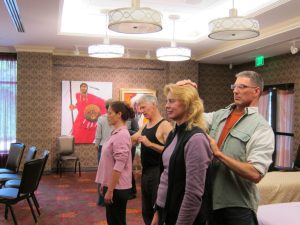
The group is intentionally kept small so there is enough time for individual observation, correction, questions, hands-on refinement, and integration.
For practitioners who would like to get a sense of my teaching before committing to the year, I am also offering free two-hour introductory classes in January, February, and March 2027.